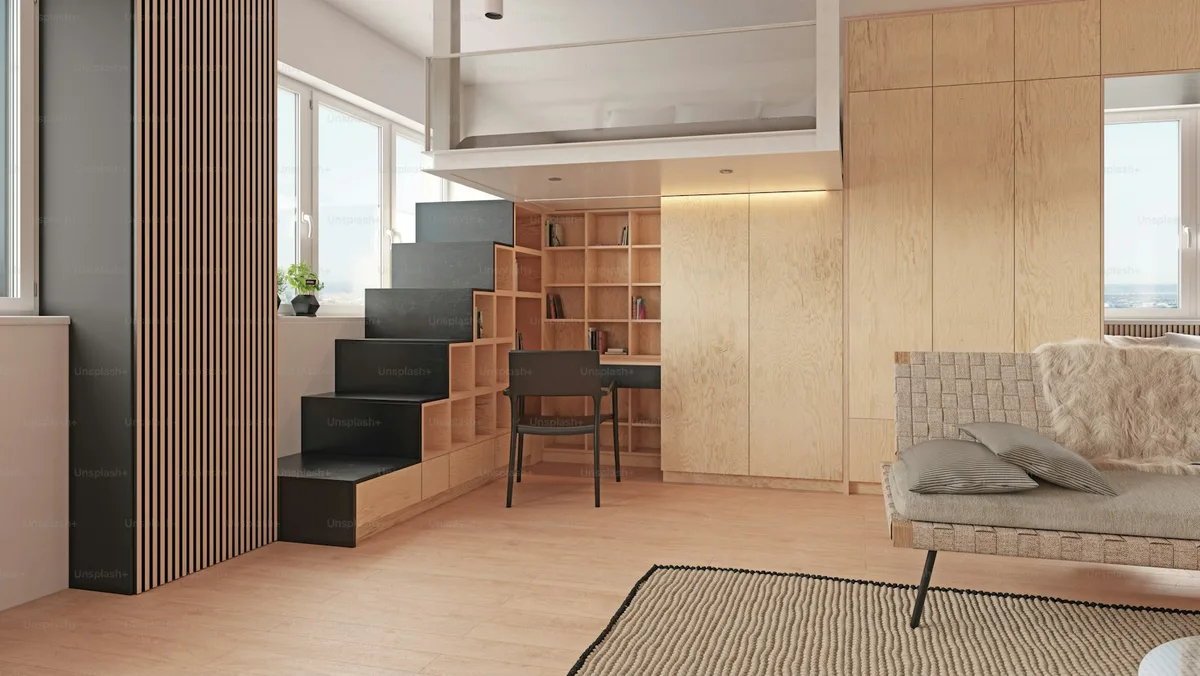
TL;DR - Stop fighting for floor space and use the walls. Go vertical with tall narrow shelving, pegboards, over-door racks, and the top-of-wardrobe zone. Hide the rest inside dual-purpose furniture: storage ottomans, drawer or gas-strut beds, hollow benches, and mirror cabinets. Renters can do most of this with tension rods and adhesive rails, no drilling required. Find studs before hanging anything heavy, and never buy a bin deeper than your arm.
How do you store more in a small space? You stop fighting for floor and start climbing the walls. In a typical studio the floor is full within a fortnight of moving in, while the walls above eye level sit empty. Vertical shelving and furniture that hides things can double what a room holds.
Small rooms don't have a stuff problem. They have a wasted-height problem. Let me show you where that height is hiding.
Why should you store things vertically?
Floor space is finite. You bought whatever square metres you bought, and no clever bin adds more. Wall space, on the other hand, sits mostly empty above the one-metre line in almost every home. That's the space to claim.
Tall narrow shelving is the workhorse. A unit 30 cm deep and 180 cm tall takes a sliver of floor and gives you five or six full levels. Over-door organizers cost almost nothing and turn dead door-backs into rows of pockets or a rack with six hooks. Wall-mounted pegboards and rails put pans, tools, and mugs out in the open where you can actually grab them.
Then there are the zones people forget. Above the door. Above the kitchen cabinets. The top of the wardrobe. Floating shelves that ride the wall with no visible bracket. A single floating shelf above a desk takes the books off the work surface, and a cleared desk reads as twice the size. Isn't it strange how the emptiest part of a small room is usually the top half?
Here's my opinion, and some will disagree: a matching furniture set is the enemy of a small home. Mismatched vertical pieces that each earn their spot beat a coordinated suite that eats the floor.
What hidden and dual-purpose furniture works best?
The other half of the game is furniture that does two jobs. Storage ottomans are the easiest entry point. They hold blankets and clutter, then serve as a footrest or a spare seat when friends turn up. If you want the full argument for them, I made the case in this piece on decorating with a storage ottoman.
Beds are the biggest missed opportunity in any bedroom. A frame with built-in drawers reclaims the space under the mattress. Better still, a lift-up gas-strut base rated around 200 kg swings the whole platform up on two struts and reveals one enormous bin underneath. Hollow benches do the same trick by the front door. Sofa-back consoles, only 15 to 20 cm deep, sit behind the couch and hold remotes, chargers, and a lamp.
Got stairs? Under-stair drawers or a pull-out pantry turn that awkward triangle into serious capacity. And a mirror cabinet in the bathroom gives you a full mirror plus three shelves of hidden medicine and toiletries in the same footprint as a plain mirror.
Which move fits each room?
Here's the quick reference. One best vertical move and one best hidden move per room.
| Room | Best vertical move | Best hidden move |
|---|---|---|
| Entryway | Over-door rack with 6 hooks | Hollow shoe bench |
| Bedroom | Top-of-wardrobe boxes | Gas-strut lift-up bed base |
| Kitchen | Wall rail for pans and utensils | Above-cabinet lidded bins |
| Bathroom | Tall corner tower | Mirror cabinet |
| Living room | Floating shelves | Storage ottoman |
Print it, screenshot it, whatever helps. Each cell is the highest-return single change for that room, not a shopping list of ten things you'll never finish.
What can renters do without drilling?
Plenty, actually. Tension rods are the unsung hero. One wedged inside a cabinet holds spray bottles by their triggers; one across a narrow alcove becomes a hanging rail. Adhesive rails and hooks rated for 2 to 3 kg carry keys, utensils, and light baskets, and they peel off cleanly when you leave. Freestanding ladder shelves and over-door racks need no fixings at all.
Where should you spend versus save? Spend on the piece you use daily and lift often, like the bed base or the ottoman you sit on. Save on decorative shelving and door organizers, where the cheap version does the same job. One well-chosen anchored shelf beats five wobbly bargain ones every time.
If your small home is also a smart home, keep hubs and chargers off the counter and onto a shelf or inside a console. My smart home starter guide walks through which gadgets actually earn their spot.
What are the common small-space storage mistakes?
Three traps catch almost everyone.
First, overloading walls without finding the studs. Plasterboard alone holds only a few kilos on a plastic plug before it tears out. Find the stud, or use the right anchor for the load. The Family Handyman anchor guide breaks down which fixing carries what, and it's worth two minutes before you hang a full shelf of books.
Second, buying deep bins you can't reach into. A 60 cm-deep basket looks like more storage. In practice the back third becomes a place things go to be forgotten. Measure your arm's reach, then buy shallower.
Third, cramming clutter behind doors until they won't shut, or worse, blocking the path to an exit. Keep escape routes clear. NFPA's home fire escape plan tells you to mark two ways out of each room and check that routes are clear, which is a good sanity check on where storage should never go. A door that opens fully is worth more than the extra rack you crammed behind it.
Small spaces reward restraint. Claim the height, hide what you can, and be ruthless about the depth of every bin you bring home.