The technician hands you an estimate for $1,800. The part is a compressor, the air conditioner is eleven years old, and he's already got the truck running. Do you pay it?
There are two popular rules for that moment, and I ran the math on both. They give opposite answers on the same bill more often than you'd expect. This guide prices the repairs, prices the replacement, and shows where each rule flips. For the baseline replacement numbers and the refrigerant switch behind them, start with our fall 2026 HVAC upgrade cost guide. This one picks up at the question that guide leaves open.
What Do Common HVAC Repairs Cost in 2026?
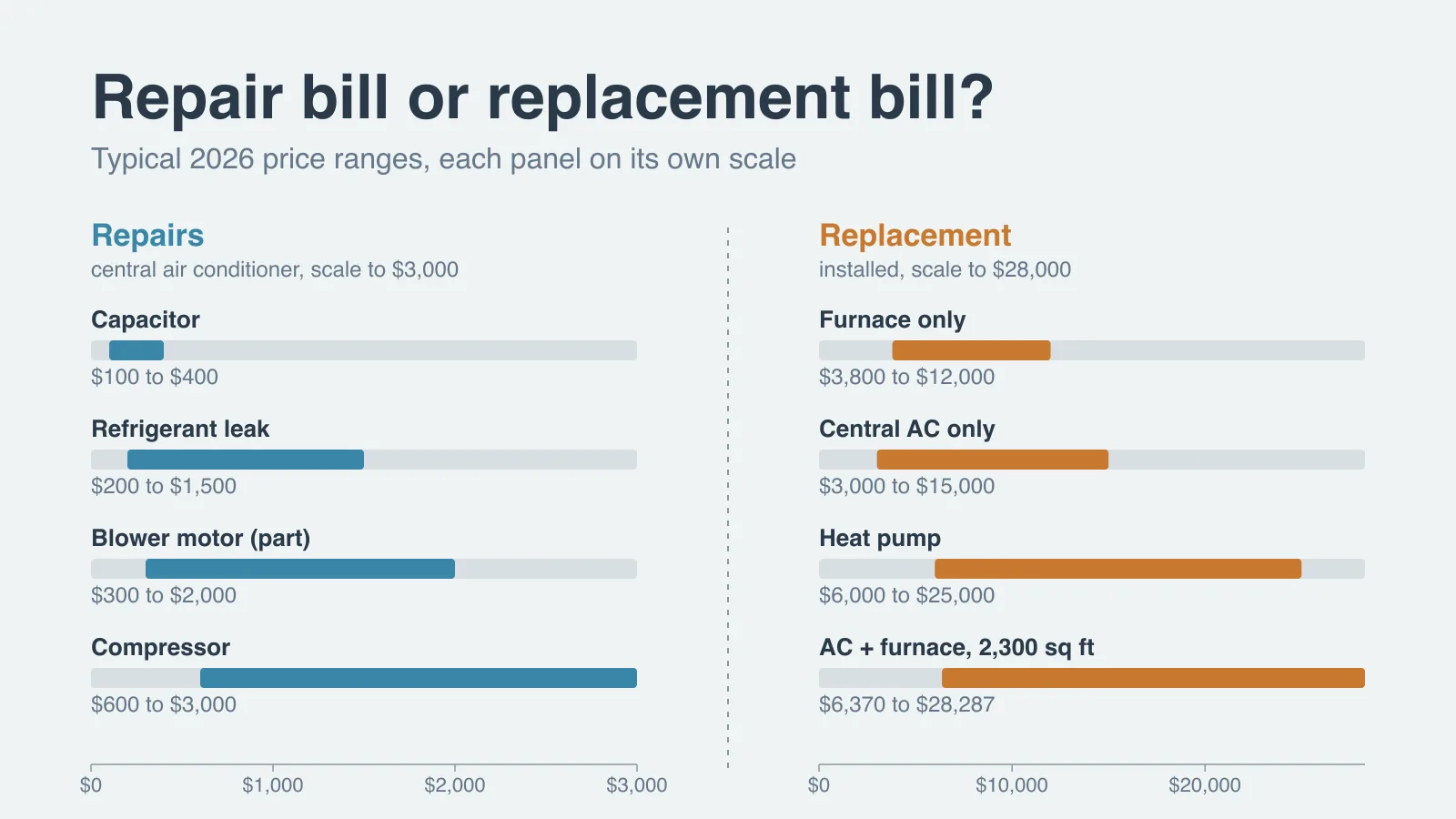
Most repairs land between $150 and $700. Fixr's AC repair guide, updated in January 2026, reports an average of $375 with a typical range of $250 to $700. This Old House (updated March 2026) says most homeowners pay $150 to $650 for common fixes. The ranges below are per part, so you can match them against the line items on an estimate.
| Central AC repair | Typical range | Source |
|---|---|---|
| Condensate line cleared | $75 to $250 | Fixr, Jan 2026 |
| Capacitor | $100 to $400 | Fixr, Jan 2026 |
| Thermostat | $150 to $500 | Fixr, Jan 2026 |
| Refrigerant recharge | $100 to $600 | Fixr, Jan 2026 |
| Refrigerant leak repair | $200 to $1,500 (average about $800) | Fixr, Jan 2026 |
| Blower motor (as a repair) | $200 to $900 | Fixr, Jan 2026 |
| Evaporator coil | $400 to $2,700 | Fixr, Jan 2026 |
| Compressor | $600 to $3,000 | Fixr, Jan 2026 |
| Compressor (second opinion) | $1,000 to $3,000 and up | This Old House, Mar 2026 |
Furnaces price differently, because the figures include the service call as well as the part. Fixr's furnace page gives a national average of $485, with most repairs from $349 to $650. One caution: that page was last updated in August 2025, so treat it as a year older than the AC data above.
| Furnace repair (call plus parts) | Typical range |
|---|---|
| Flame sensor | $68 to $127 |
| Ignitor | $96 to $178 |
| Control board | $390 to $725 |
| Blower motor | $562 to $1,045 |
| Heat exchanger | $1,346 to $2,673 |
So where's the line? Everything above the heat exchanger and compressor rows is a bill I'd pay without a second thought on any system under about 15 years old. That's my opinion, and it rests on one fact in the tables: those parts cost a few hundred dollars, and a replacement costs thousands.
What Does Replacement Cost Instead?
A full air conditioner plus gas furnace swap in a 2,300 square foot home averages $12,578, per This Old House's June 2026 update. The spread is huge. The low case, at the federal minimum 12.4 SEER2 rating, is $6,370. The high case, at 16.1 SEER2, is $28,287.
| Replacement scope | Range | Midpoint or median | Source |
|---|---|---|---|
| AC plus gas furnace, 2,300 sq ft | $6,370 to $28,287 | $12,578 average | This Old House, Jun 2026 |
| Furnace only | $3,800 to $12,000 | $7,900 median | Pearl SCORE, May 2026 |
| Central AC only | $3,000 to $15,000 | $9,000 median | Pearl SCORE, May 2026 |
| Air-source heat pump | $6,000 to $25,000 | $8,350 median | Pearl SCORE, May 2026 |
A warning about the second source. Pearl SCORE is a commercial site, not a government survey, and it claims prices are running about 10 percent higher than a year ago without citing where that comes from. I'm quoting its ranges because they're the only per-component replacement prices I could open this week, not because I trust them more than a written local quote.
What Moves a Replacement Quote?
Four things do most of the work, and only one of them is a choice you make.
Size and efficiency
This Old House puts the rule of thumb at about 1 ton of cooling per 500 to 600 square feet, so a 2,300 square foot home usually needs 4 tons. ENERGY STAR says a system that's too big or too small will struggle, and tells you to ask the contractor to verify the size with a Manual J load calculation. If a quote shows a tonnage and no calculation, ask where the number came from.
Efficiency is the one you choose. The average price barely moves across the first four SEER2 tiers, then jumps.
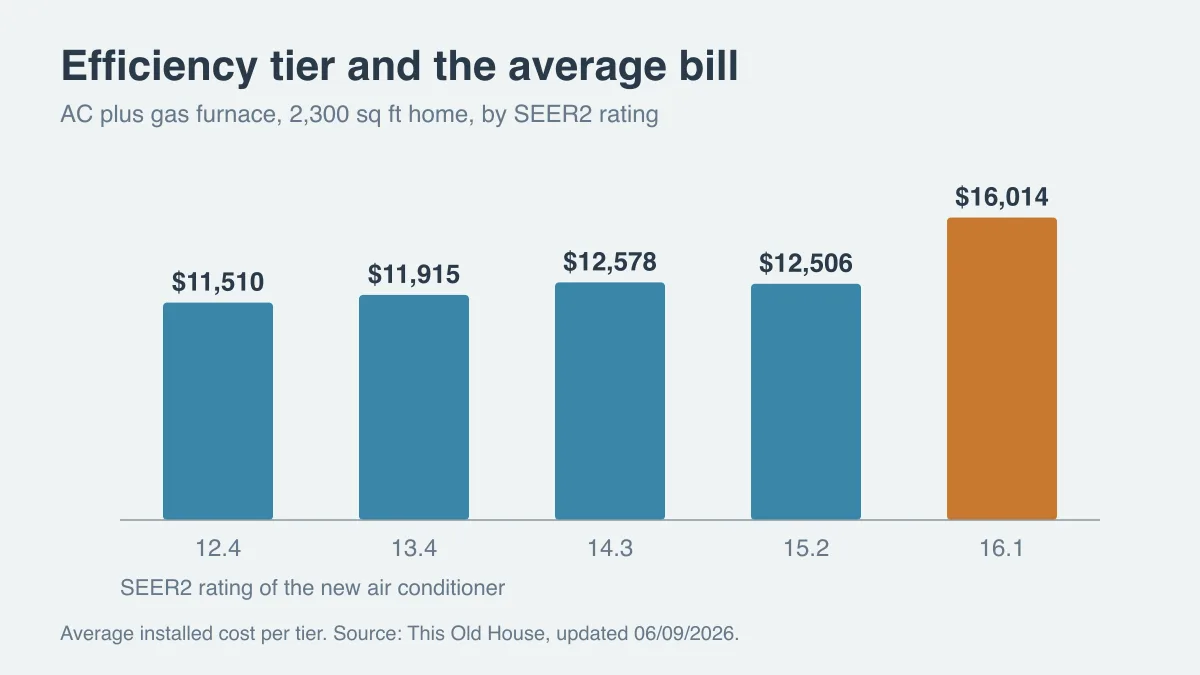
The step from 15.2 to 16.1 SEER2 adds $3,508 on average. The step from 14.3 to 15.2 actually shows $72 less, which tells me the underlying quotes are noisy, not that a better unit is cheaper. This Old House also notes the minimum is 12.4 SEER2 nationally but 14.3 in the Southeast and Southwest, so your region may remove the bottom of the table for you.
Ducts, labor and paperwork
The same source lists the extras that don't sit in the equipment price:
- Ductwork replacement: $1,500 to $3,000
- Permits: $250 to $400
- Thermostat: $39 to $217
- Labor: from $1,949 in the South to $4,440 in the Northeast and Hawaii
Equipment alone ranges from $4,935 to $17,866 in that model home. Add the top equipment figure to the top labor figure and you get $22,306, which is the upper bound of the 14.3 SEER2 row before the ducts. If your attic runs are bare, our attic duct insulation guide covers the part of the duct bill you can shrink yourself.
When you call
Labor costs are usually higher in high-demand summer months, and emergency service on nights, weekends and holidays costs more than a scheduled visit, according to This Old House. Pearl SCORE says emergency calls can run 1.5 to 2 times the normal labor rate, which is its claim and not something I could cross-check.
Which Rule Tells You to Repair or Replace?
There are two. CBS News described the first on June 24, 2026: multiply the age of the system by the estimated repair cost. Above $5,000, replacement is often the better long-term option. Its examples are a 12-year-old unit with a $500 repair (6,000, replace) and a 7-year-old unit with a $400 repair (2,800, repair).
The second is the 50 percent rule. Both Fixr and This Old House say that if a repair costs more than half of what a replacement would, replace. This Old House adds a few flags: frequent breakdowns, a unit past 12 years, R-22 refrigerant, or rising energy bills.
Same bill, different rules. Why do they disagree?
Because they measure different things. The first one ignores what a new system costs. The second one ignores how old yours is. Run them side by side and the gap shows up fast. Here's my arithmetic, using repair figures from the tables above and the Pearl SCORE medians for the 50 percent line:
| Scenario | Age x cost | $5,000 rule | Half of replacement | 50% rule |
|---|---|---|---|---|
| Capacitor, $250, 14-year AC | 3,500 | Repair | $4,500 (AC only) | Repair |
| Refrigerant leak, $800, 11-year AC | 8,800 | Replace | $4,500 | Repair |
| Blower motor, $900, 12-year AC | 10,800 | Replace | $4,500 | Repair |
| Compressor, $1,800, 10-year AC | 18,000 | Replace | $4,500 | Repair |
| Heat exchanger, $2,000, 15-year furnace | 30,000 | Replace | $3,950 (furnace only) | Repair |
Four of five rows split. In every split the age rule says replace and the money rule says repair.
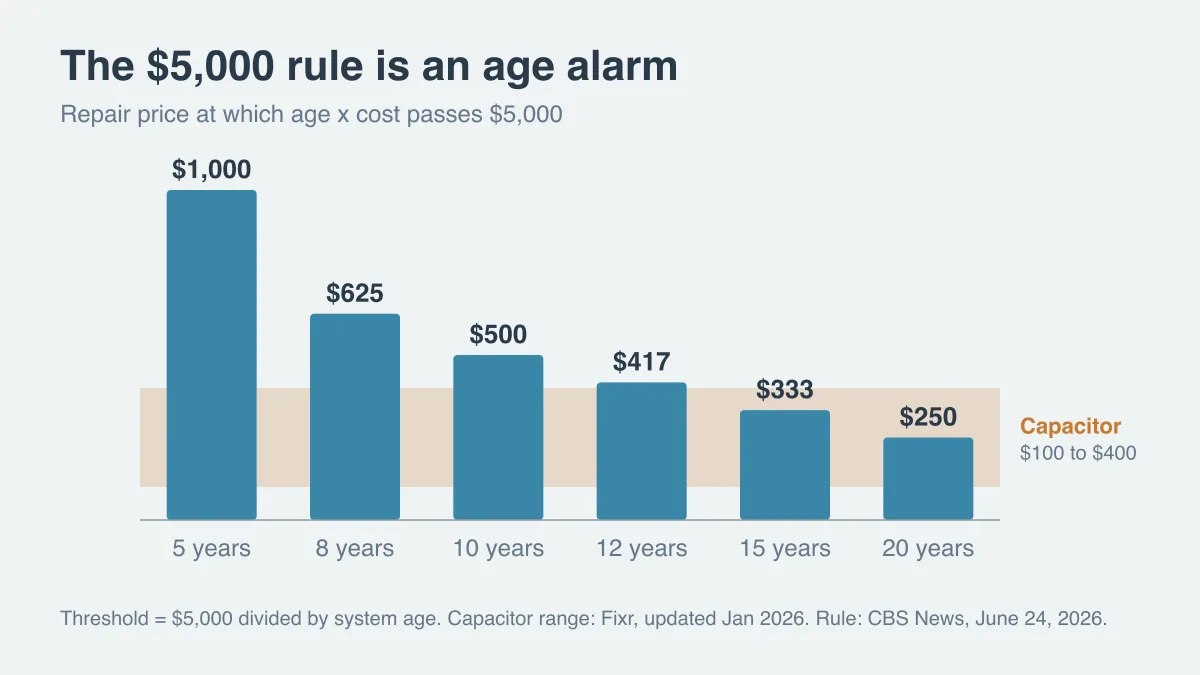
The $5,000 rule isn't a cost test. After year ten it's an age alarm that goes off at $500.
The arithmetic is simple: $5,000 divided by the age gives the repair price where the rule flips. At 5 years it's $1,000. At 10 years it's $500, at 15 years $333 and at 20 years $250. A capacitor at the top of its $100 to $400 range crosses that line on any system older than 12.5 years. Is a $400 capacitor really a reason to spend $9,000?
CBS itself calls the rule a starting point and lists what it leaves out: the type of repair, the repair history, rising energy bills, and costly or hard-to-find refrigerant in older units. The 50 percent rule has its own blind spot. A repair that's under half the price of a new unit can still be a bad buy if it's the third one this year.
My read, and you can disagree: use the 50 percent rule as the price test and the age rule as a prompt to ask better questions. If both say replace, replace. If only the age rule says replace, the system's age, repair history and refrigerant should break the tie, not the multiplication.
One row needs extra care. A cracked heat exchanger is a safety question as well as a money one, and none of the pages I opened settles what a repair can do about it. Get that diagnosis in writing, get a second tech to look, and don't let a $2,000 estimate on a 15-year-old furnace pass without both.
Does Fall Change the Math?
Not the repair prices. It changes how many bids you can collect and how fast.
Trane's November 2025 post says fall is a shoulder season, HVAC companies are generally less busy than in winter or summer, and you can get multiple quotes faster. It adds that manufacturers, Trane included, usually run national consumer promotions in fall, and that distributors may clear inventory of outgoing models before year end. It also warns not to count on bargain basement prices. That's a manufacturer's marketing page, so I take the scheduling claim seriously and the promotion claim as a maybe.
For the repair-or-replace decision, here's what that means in practice. A fall repair is a scheduled visit. A January repair is an emergency, and the emergency premium (1.5 to 2 times labor, per Pearl SCORE) lands on the same part. If your tune-up in September or October turns up a weak component, that's the cheapest moment to price both options. Our September checklist covers the furnace tune-up, and the autumn prep cost breakdown puts a price on the tune-up itself.
What Help Is There Toward the Bill?
Less than last year. The federal 25C credit is over for 2026 installs. The IRS page says the credit is allowed for qualifying property placed in service on or after January 1, 2023, and before December 31, 2025. ENERGY STAR's tax credit page gives the same end date and describes what it used to pay: 30 percent up to $2,000 for an air-source heat pump, and up to $1,200 for furnaces, central air and other upgrades.
What's left is the state-run HEAR rebate. Filterbuy's guide, updated August 31, 2026, says it pays up to $8,000 toward a heat pump at the point of sale. Households at or below 80 percent of area median income get the full amount, those between 80 and 150 percent get a partial one, and it only works where a state has launched the program. The same page notes California reported its single-family rebates fully reserved as of February 24, 2026, with remaining requests waitlisted.
State trackers disagree with each other. The one I opened was dated February 2026, and its list of open states differs from what newer search snippets claim, so I can't tell you which states are open today. Check your state energy office before you plan around any rebate. None of the pages I opened mention a rebate for repairs. These programs pay for equipment.
What Order Would I Do It In?
I haven't replaced an HVAC system, and this guide isn't a test of anyone's equipment. Every figure above comes from a page I opened and read for this article, and the comparison table is my own arithmetic, so check it against your own estimate. With that said, here's the order I'd follow:
- Get the diagnosis in writing: the failed part, the labor, and the diagnostic fee. Fixr lists a minimum service fee of $75 for simple issues.
- Write down the age of the system and what refrigerant it uses. This Old House flags R-22 units as a replacement signal.
- Run both rules. If they agree, you're done. If they split, count the repairs from the last two years.
- Ask the same contractor for a replacement quote with a Manual J load calculation, and get a second replacement quote. Compare line by line, ducts and permits included.
- If the unit is past 15 years and the repair is a compressor or coil, price the replacement before you approve the repair.
If you're weighing a new heating system against envelope work, read the cost to insulate a house first, because a tighter house can mean a smaller system. And if the question is a single cold room or outbuilding rather than the whole house, the garage mini-split versus insulation comparison shows how that math runs on a smaller scale.