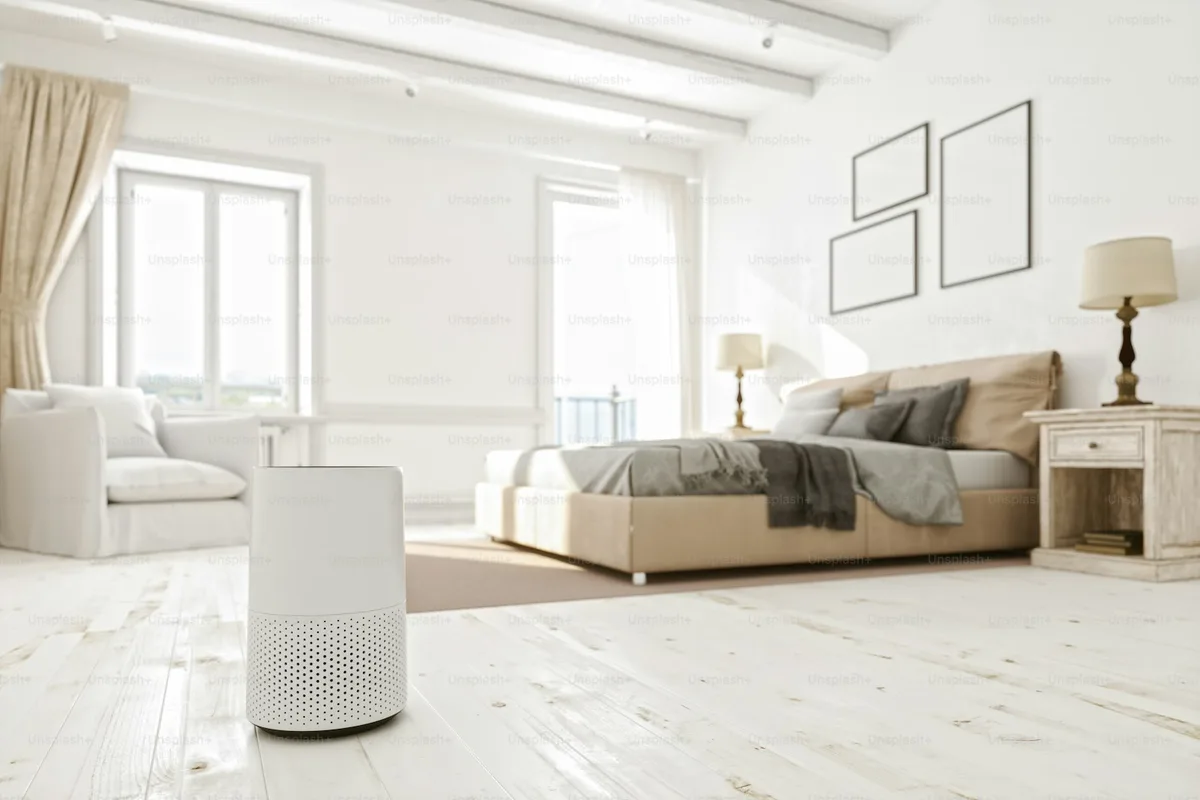
Most people size an air purifier by the number on the box, and the number on the box is usually the pollen CADR, the flattering one. Here's the short version: match the machine's smoke CADR to your room's square footage using the 2/3 rule, then confirm it hits 4 to 5 air changes an hour. That's the whole trick.
TL;DR Pick a purifier whose smoke CADR is at least two-thirds of your room's floor area in square feet. A 300 sq ft bedroom needs a smoke CADR near 200 CFM. For allergies, size up so you get 4 to 5 air changes per hour.
What Does CADR Actually Measure?
CADR stands for Clean Air Delivery Rate. It's a number certified by AHAM, the Association of Home Appliance Manufacturers, after independent lab testing. Every certified unit gets three CADR numbers, not one: smoke, dust, and pollen. Each is measured in cubic feet per minute (CFM).
Why three? Because particle size changes how fast a filter clears the air. Smoke particles are the tiniest of the three, roughly 0.09 to 1 micron. Pollen is huge by comparison, 5 to 11 microns. A filter grabs big pollen easily, so the pollen CADR is almost always the highest number on the box.
Here's my rule, and I'll die on this hill: trust the smoke CADR. It's the hardest test to pass, so it's the honest one. If a purifier moves smoke well, it moves everything larger too. Marketing loves the pollen number because it's bigger. Ignore that.
How Do You Match CADR to Room Size?
AHAM publishes a simple guideline called the 2/3 rule. Take your room's floor area in square feet. Multiply by two-thirds. That's your minimum smoke CADR, assuming standard 8-foot ceilings.
So a 150 sq ft room needs a smoke CADR of at least 100. A 300 sq ft room needs about 200. Easy. The EPA's air cleaner sizing chart lands in nearly the same place, at 195 cfm for 300 sq ft.
But the 2/3 rule only gets you a baseline of roughly 4 to 5 air changes per hour (ACH), which matches the 4.8 ACH that AHAM Verifide units are tested to deliver for their suggested room size. ACH is exactly what it sounds like: how many times per hour the purifier cycles your room's entire air volume.
Worked example. Take a bedroom 12 by 14 feet, so 168 sq ft, with 8-foot ceilings. Air volume is 168 x 8 = 1,344 cubic feet. At 5 ACH you need to clean 1,344 x 5 = 6,720 cubic feet every hour. Divide by 60 minutes and that's about 112 CFM of clean air. So a smoke CADR around 110 to 120 is the floor for that room. Notice that lines up with the 2/3 rule (168 x 0.67 = 113). The two methods agree, which is the whole point.
Want more than 5 ACH for wildfire season or a cat that sheds like a snowstorm? Size up. There's no penalty for extra CADR except a little noise and price.
What Minimum CADR Does Each Room Size Need?
| Room size (sq ft) | Air volume (8 ft ceiling) | Minimum smoke CADR (2/3 rule) | Rough ACH delivered |
|---|---|---|---|
| 150 | 1,200 cu ft | 100 CFM | ~5 ACH |
| 300 | 2,400 cu ft | 200 CFM | ~5 ACH |
| 500 | 4,000 cu ft | 335 CFM | ~5 ACH |
| 700 | 5,600 cu ft | 470 CFM | ~5 ACH |
Two real units anchor this. The Levoit Core 300 carries a smoke CADR around 135 CFM, which comfortably covers a 150 to 200 sq ft bedroom at 5 ACH. Step up to something like the Coway Airmega 400, with a smoke CADR near 350 CFM, and you're covering a 500 sq ft open living area at the same rate.
Does HEPA Change the CADR Math?
Short answer: no, but it matters. True HEPA (sometimes labeled H13) captures 99.97% of particles at 0.3 microns, the hardest size to trap. CADR already bakes in the filter's efficiency and the fan's airflow together, so a high smoke CADR usually means a real HEPA filter sitting behind a strong fan.
Watch the wording, though. "HEPA-type" or "HEPA-like" is not the same as True HEPA. Those knockoff filters can miss the 0.3 micron mark by a lot. If a unit skips AHAM certification and also says "HEPA-type," leave it on the shelf.
Two sizing mistakes to avoid:
- Oversizing to be safe, then running the unit on its lowest, quietest setting. Your 350 CADR machine now delivers maybe 120. You paid for capacity you switched off.
- Undersizing and cranking it to max forever. It's loud, the filter wears out fast, and you still fall short of 4 ACH.
Match the CADR to the room, then run it on medium. That's the sweet spot. For more whole-home thinking, our beginner's guide to smart home setups covers where air quality fits alongside everything else.
How Do You Read the Label Without Getting Fooled?
The big one: "covers up to 1,500 sq ft." That claim almost always assumes a feeble 2 ACH, which is fine for a stuffy office but useless for allergies. Take any "covers up to X" number and, if you actually care about clean air, cut it in half. That gets you back to a real 4 to 5 ACH room.
Look for the AHAM Verifide seal and the three CADR numbers printed together. If a listing hides the CADR and shows only coverage area, that's a tell. You can look up any certified model in the AHAM Verifide directory before you buy.
One more habit worth building: think about pets and dust together. If shedding is your main problem, a good robot vacuum for pet hair removes the settled dander a purifier can't reach, so the two work as a pair. Filters catch what's airborne. Vacuums catch what's landed.
So, what size air purifier do you need? Measure the room, multiply the square footage by two-thirds, and buy a unit whose smoke CADR clears that. Then run it on medium and get on with your day.