
Your furnace works fine. The air conditioner is sized correctly. And somewhere above your bedroom ceiling, a metal tube sits in 120 degree air trying to deliver 58 degree air to a register twenty feet away.
That gap is the whole problem. Attic duct insulation exists because we put the distribution system in the one part of the house that swings hardest away from the temperature we're paying for.
Why Is the Attic the Worst Place for a Duct?
Allison Bailes at Green Building Advisor ran the arithmetic for an Atlanta summer design day: 92 degrees outside, 75 inside, roughly 120 degrees in the attic, 58 degree air in the ducts. On a 3,500 square foot house, R-8 wrap still let through 5,227 BTU per hour of extra cooling load. Call it half a ton of cooling bought and thrown away.
His framing is the one that stuck with me. The largest temperature difference anywhere in the house gets the lowest R-value of any assembly in it. Your attic floor might be R-49. The duct lying on top of it is R-8.
What Does the Code Actually Require?
Here's where a lot of search results get it wrong. People look up attic duct insulation R-value expecting a climate zone table, and plenty of sites happily print one. The residential IECC doesn't have one.
Section R403.3.1 is flat across the country. The wording shifted between editions, and since states adopt different ones, both are worth knowing:
| Edition | Duct location | 3 inch diameter and larger | Under 3 inch diameter |
|---|---|---|---|
| 2018 | In an attic | R-8 | R-6 |
| 2018 | Other parts of the building | R-6 | R-4.2 |
| 2021 | Anywhere outside conditioned space | R-8 | R-6 |
The 2021 edition folded the two rows into one and raised the floor for ducts outside the envelope generally. For an attic duct the answer never moved: R-8. The 2024 edition renumbers it to R403.3.3 and keeps the same figures.
Zone 2 in Phoenix, zone 6 in Vermont, same R-8. Climate zone changes two things though, and both matter. It changes whether R-8 is enough, which is a physics question rather than a legal one. And it changes the rules if you bury the ducts, which is where the zone letters finally turn up.

Why Seal Ducts Before You Insulate Them?
This is the step people skip, and skipping it wastes everything that comes after.
ENERGY STAR puts it plainly: in a typical house, about 20 to 30 percent of the air moving through the duct system is lost to leaks, holes, and poorly connected ducts. Wrapping insulation around a leaking joint does nothing about the leak. You've just made the hole harder to find.
Use mastic, brushed on thick, or a UL-rated metal tape. ENERGY STAR is direct about the obvious-sounding alternative: never use duct tape, because it isn't long lasting. It dries, curls, and drops off in a hot attic within a few seasons, leaving a duct that looks sealed and isn't.
Seal the boots where ducts meet the ceiling registers too. Those are usually the worst offenders and the easiest to reach.
Wrap, Rigid Board, or Spray Foam?
Attic duct wrap is a fiberglass blanket with a foil facing, sold by R-value, and it's what most retrofits actually use. Cheap, forgiving around round flex duct, and the foil face doubles as the vapor retarder. Tape those facing seams properly or you'll get condensation inside the blanket, which is the same error that ruins basement insulation when the vapor barrier ends up on the wrong side.
One trap worth knowing before you buy: the R-value on the bag is not the R-value on the duct. Wrap gets strapped down to about 75 percent of its out-of-package thickness, and manufacturers publish both numbers. Johns Manville rates its 2 inch Microlite at R-6.9 loose and R-5.6 installed. The 3 inch goes R-10.3 loose, R-8.3 installed.
This isn't a manufacturer's disclaimer you can wave off. The residential code makes the same assumption in the same direction: IRC section M1601.3 says that for duct wrap, installed thickness shall be assumed to be 75 percent of nominal. And the IECC specifies that minimum duct insulation values are installed R-values. So 3 inch wrap is what actually clears an R-8 attic requirement. Two inch does not, however the label reads.
Rigid board is really for building duct, not wrapping existing round duct.
Spray foam encapsulation is the premium route. Closed cell foam goes straight onto the duct, sealing and insulating in one pass, and it won't sag in five years. It costs a lot more and it isn't a DIY material.
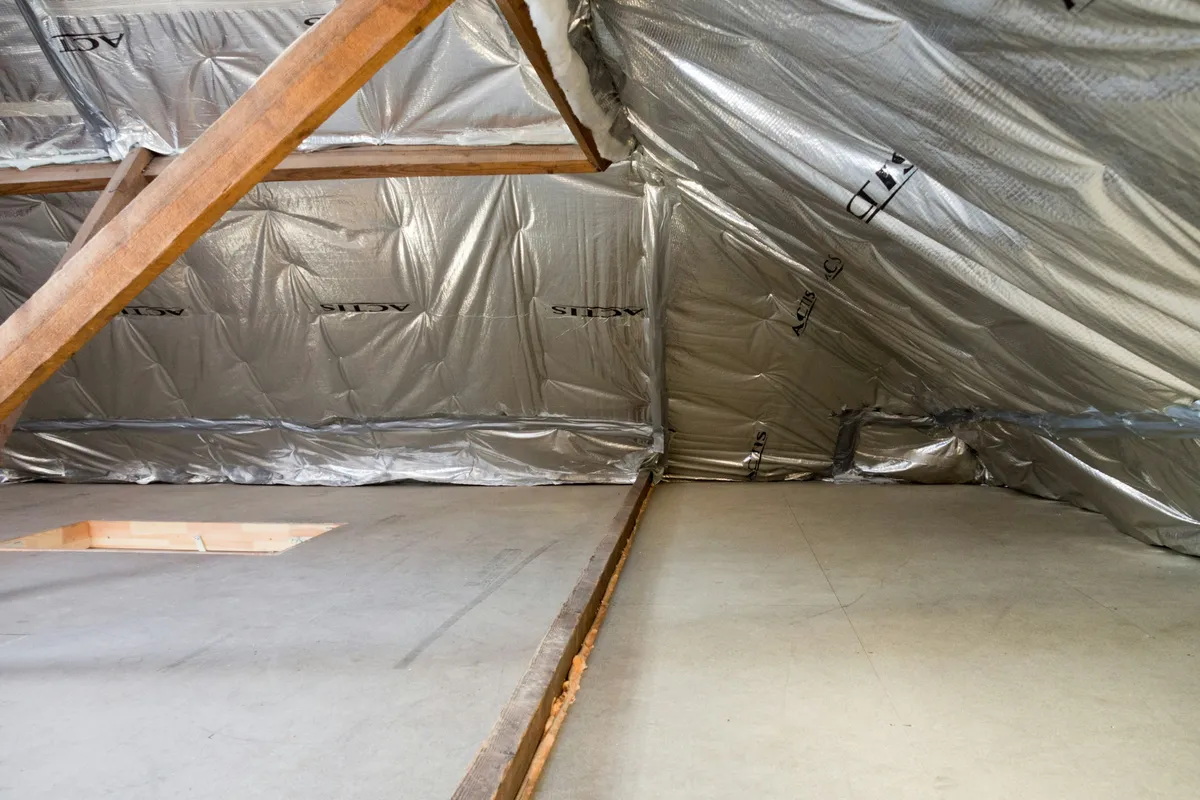
Then there's burying. Code section R403.3.6 lets you bury attic ducts in the ceiling insulation, with specific numbers: R-8 on the duct itself, plus ceiling insulation above and below totalling at least R-19, not counting the duct's own wrap. Go deep enough, meaning within 5.5 inches of the ceiling under R-30 or more of blown insulation with at least 3.5 inches above the duct, and you can claim an effective R-25 in an energy model.
Now the catch, and it's the only place climate zone letters appear. In zones 0A, 1A, 2A and 3A, the humid South, supply ducts must be fully buried under at least R-13 with vapor retarder requirements attached. That isn't bureaucratic fussiness. A 58 degree duct buried in insulation in Houston humidity is a condensation experiment, and the code is trying to stop you running it.
Flex or Rigid Metal?
Flex duct is fine. Flex duct installed badly is a disaster, and the whole difference is whether it's pulled tight.
Lawrence Berkeley National Laboratory measured it. Abushakra, Walker and Sherman found that moderate compression, the kind routinely seen in real field installations, raised pressure drop by a factor of four. Compress it further and you approach a tenfold increase.
Four times the resistance. From slack.
So my rule is boring and I'll defend it anyway: rigid metal for the trunk, flex only for short final runs to the registers, every flex run stretched drum tight and supported so it can't sag between joists. A drooping flex run in an attic is a duct you're heating for nothing.
Should the Ducts Be Up There at All?
The honest question, finally. If you're already opening the ceiling, replacing the system, or re-roofing, thicker wrap is the wrong place to put the money.
Better answers, roughly by cost: move the ducts into conditioned space, bring the attic inside the thermal envelope by insulating at the roof deck instead of the ceiling, or drop ducts altogether for ductless mini-splits.
That isn't what someone searching for attic duct wrap wants to hear, and I know it. So here's the version that fits a weekend. If the system is staying put, seal thoroughly, wrap to R-8 at minimum, and go heavier if your attic needs it. That's a genuine improvement. It just isn't the ceiling of what's possible, and nobody selling wrap is going to bring it up. One check before you add depth up there: bath fan duct and attic moisture decides whether more insulation helps or hurts. And if you're pricing the job, the attic insulation cost calculator puts bags and a crew side by side.
The September maintenance list covers the rest of the pre-winter HVAC jobs. If the system itself is near replacement age, fall HVAC upgrade costs is the number to have first. Every degree the attic steals is one you already paid for at the furnace.