Last month we published the real cost breakdown for exterior foam, and the number that stuck with readers was the smallest one: the boards are the cheapest line on the invoice. Labor, re-siding, and window work are where the money goes.
Which raises the obvious question. If the labor is the expensive part, why not supply the labor yourself?
Sometimes you should. Sometimes that's the most expensive decision you'll make on the house, and the difference isn't skill. It's six properties of your wall that you can score before you buy anything. I haven't priced foam at a till this autumn, so the dollar figures here come from the cost article and the public guides it cites; what this piece adds is the matrix.
What the Job Actually Is
Strip the siding. Repair whatever it was hiding. Hang boards against the sheathing, tape every seam, lap the water-resistive barrier so water drains out and not in. Screw vertical furring strips through the foam into the studs. Extend every window and door jamb to the new wall depth, re-flash each opening, then put cladding back on over the strips.
That's seven jobs. Only one of them is "insulation."
The foam-handling part is genuinely easy. EPS and polyiso cut with a knife or a saw, weigh almost nothing, and forgive sloppy measuring because the tape covers the seam. If exterior foam were only that, every handy homeowner would do it in a weekend.
The furring is the first place DIY gets harder than it looks. GreenBuildingAdvisor's guidance on fastening furring strips walks through the screw length, spacing and the fact that the strips are carrying the siding's weight across a compressible layer. Miss a stud, and you find out when the cladding sags.
The Thickness Question Decides Half of This
Before scoring anything, settle the thickness, because it changes the labor and the risk at the same time.
Rigid foam on the outside of a wall slows vapor leaving the sheathing. That's fine if the foam is thick enough to keep the sheathing warm all winter; it's a moisture trap if the foam is too thin. The 2021 IRC, section R702.7, sets the minimum continuous insulation R-value for a wall that relies on a Class III vapor retarder (ordinary latex paint): R-5 over a 2x4 wall and R-7.5 over a 2x6 wall in climate zone 5, R-7.5 and R-11.25 in zone 6, and R-10 and R-15 in zones 7 and 8. Zone 4 gets away with R-2.5 and R-3.75. Martin Holladay's thickness article explains the physics behind the table and why it's a floor, not a target.
Convert that to inches. Polyiso is about R-6 per inch, XPS about R-5, EPS about R-4. A zone 6 house with 2x6 walls needs roughly two inches of polyiso or three of EPS. A zone 7 house needs more.
Why does this matter for the DIY question? Two inches of foam turns every window into carpentry: extension jambs, new sills, a flashing sequence that has to shed water in the right order. One inch barely needs it. The code table therefore sets how many hours each opening costs you, and it does that before you've touched a board. The five faults list has underspecified foam at number one for exactly this reason.
The Six-Factor Matrix
Score your wall on each row. Honest answers only; the wall doesn't care about optimism.
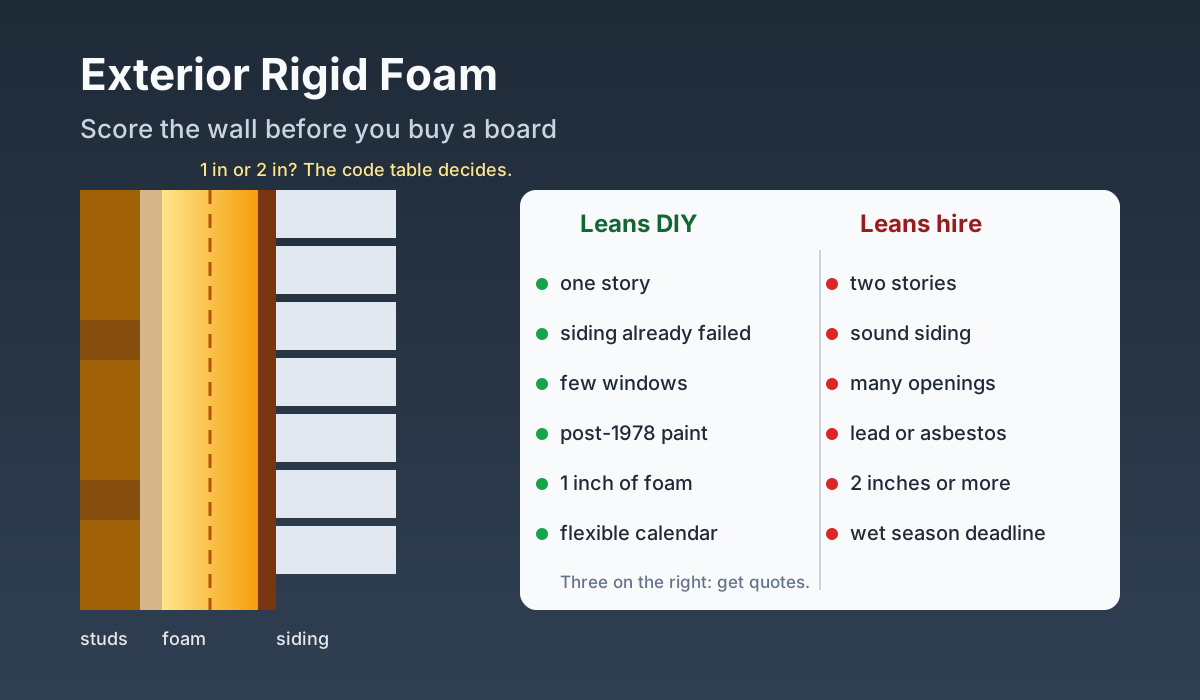
| Factor | Leans DIY | Leans hire a crew |
|---|---|---|
| Wall height | One story, ladder reaches everything | Two stories or more; scaffolding, fall risk, and a day lost to setup per side |
| Siding condition | Already failed; you're paying for strip-and-reclad regardless | Sound siding you'd be removing only to insulate; the economics rarely work either way |
| Openings | Few windows, simple trim | Many windows, bay windows, doors with sidelights; each is a half-day of flashing and jambs |
| Old finishes | Post-1978 paint, no cement-board siding | Pre-1978 paint or asbestos cement siding (see below) |
| Foam thickness | One inch or less by the code table (zone 4, maybe zone 5) | Two inches or more; every detail gets harder |
| Calendar | Flexible; walls can stay open across several weekends in dry weather | Hard deadline, wet season, or you cannot leave sheathing exposed |
Three rows in the right-hand column and I'd get quotes. Three in the left and the project is a candidate for your own hands, at least for the foam, tape and furring stages. The honest middle ground is a hybrid: hire the strip-and-dispose, hire the window flashing, do the boards and strips yourself in between. Not every crew will agree to it. Ask anyway.
The code thickness table decides your exterior foam DIY question before you buy a board: two inches of foam turns every window into carpentry.
The Two Rows That Overrule the Others
Old finishes get their own section because they aren't a matter of effort. They're a matter of law and lungs.
Paint applied before 1978 is presumed to contain lead. The EPA's Renovation, Repair and Painting rule requires certified firms and lead-safe practices for paid work that disturbs it, and stripping siding disturbs a lot of it. The rule doesn't bind a homeowner working on their own house, which sounds like a loophole. It isn't. It means you are the one responsible for the dust, the plastic sheeting, the HEPA cleanup, and the children and pets downwind of the demolition. A crew that's set up for lead-safe work does this routinely; a homeowner doing it once usually learns the containment steps on the job.
Asbestos cement siding is harder still. Rules on homeowner removal vary by state, disposal is regulated almost everywhere, and the cost article quotes licensed abatement at $5 to $20 per square foot, which can exceed the rest of the project. If your house has it, the DIY question changes shape: the real decision is whether to strip at all, or to leave the cement board in place and insulate from inside.
Is that a cop-out? Maybe. But a wall insulated from the inside and left alone outside beats a wall half-stripped by someone who found the cement board on day two.
Time, Priced Honestly
Crews quote exterior foam in days per elevation. For a homeowner it's weekends per elevation, and the wall is open in between.
That gap is a risk, not just a delay. Exposed sheathing takes rain, housewrap flaps loose, and a half-taped foam layer channels water to exactly the places you haven't flashed yet. If your climate gives you a dry season, plan the work inside it, one elevation at a time, and finish each side (foam, tape, furring, cladding) before opening the next. The gap-hunting guide is worth reading before the first weekend rather than after, because the gaps it describes are the ones a part-time schedule produces.
What about tools? Nothing exotic. A circular saw or a long knife for boards, a drill and a box of long structural screws for the furring, a level, a tape gun if you value your thumbs. Scaffolding is the one rental that changes the budget, and only on two-story walls. That's the wall height row again.
Rebates Won't Rescue Either Column
I'd love to tell you the federal credit tips the math. It doesn't exist any more. ENERGY STAR's credit page lists the 25C Energy Efficient Home Improvement Credit as ended on December 31, 2025, so 2026 projects get nothing from it. State HOMES programs and utility rebates still run in some places and reward measured whole-home savings, which exterior foam delivers. Check yours. Budget as if it pays zero.
What I'd Do With a Real House
My opinion, and plenty of siding contractors will push back: on a one-story house with failed siding, few windows, and a zone 4 or 5 thickness, do it yourself. The foam work is easier than tiling a bathroom, and the dangerous parts of the job are the ones you've already scored out of the matrix.
Anything else, get three quotes, and ask each one how they handle the window flashing sequence. The answer tells you more about the crew than the price does. And if the quotes come back in the range that makes you flinch, remember the order the cost article ended on: air seal and top up the attic first, and check the bath fan duct above the bathroom while you're up there. A wall you can foam next year is a better deal than a half-finished wall facing the first November rain.