Why Is There No Single Number for This?
Search for the cost to insulate a house and you'll get one confident figure per website. They don't agree, and the reason is simple: a house isn't one job. It's an attic, some walls, a basement or crawl space, maybe a rim joist, and each has its own materials, access problems and labor.
So this guide does it area by area, with the source named next to each range. I haven't installed any of this myself for the article. What I did was read the published 2026 price guides and the ENERGY STAR methodology, cross-check them against the sourced numbers in our other cost posts, and run the arithmetic on a worked example. Treat everything below as a planning range, never a quote.
What Does Insulation Actually Save?
ENERGY STAR's estimate is that air sealing plus insulation in attics, floors over crawl spaces and basements saves an average of 15 percent on heating and cooling costs, or 11 percent of total energy costs. The figure comes from modeling typical existing U.S. homes, so your real number moves with climate and how thin the starting insulation was.
Notice what that list leaves out: finished walls. The cheap, high-return jobs are the ones you can reach without opening anything.
How Much Does Attic Insulation Cost?
This is the baseline. CurrentCost's 2026 guide prices professionally installed blown-in cellulose at $1.40 to $2.50 per square foot, so a 1,000 square foot attic runs about $1,400 to $2,500. Fiberglass batts come in lower, at $0.90 to $1.60 per square foot in the same guide. Doing it yourself, the bags for an R-49 layer cost roughly $1,092 to $1,716 on 2026 retailer prices, and the blower is free at the big-box stores if you buy enough bags.
In cold climates the ENERGY STAR table points at R-49 to R-60 for an attic floor. The full price breakdown, with bag counts and the DIY-versus-crew math, is in the cellulose installation cost guide. Before you blow anything in, seal the hatch, because the attic hatch is often the biggest leak (see sealing the attic hatch).
What Do Exterior Walls Cost?
More, and for a reason people miss. HomeGuide puts insulating the exterior walls of a typical 2,000 square foot house at $1,700 to $8,500, and Homewyse prices basic rigid board installation at about $2.25 to $3.75 per square foot. Those numbers cover attaching foam to a wall you can already reach.
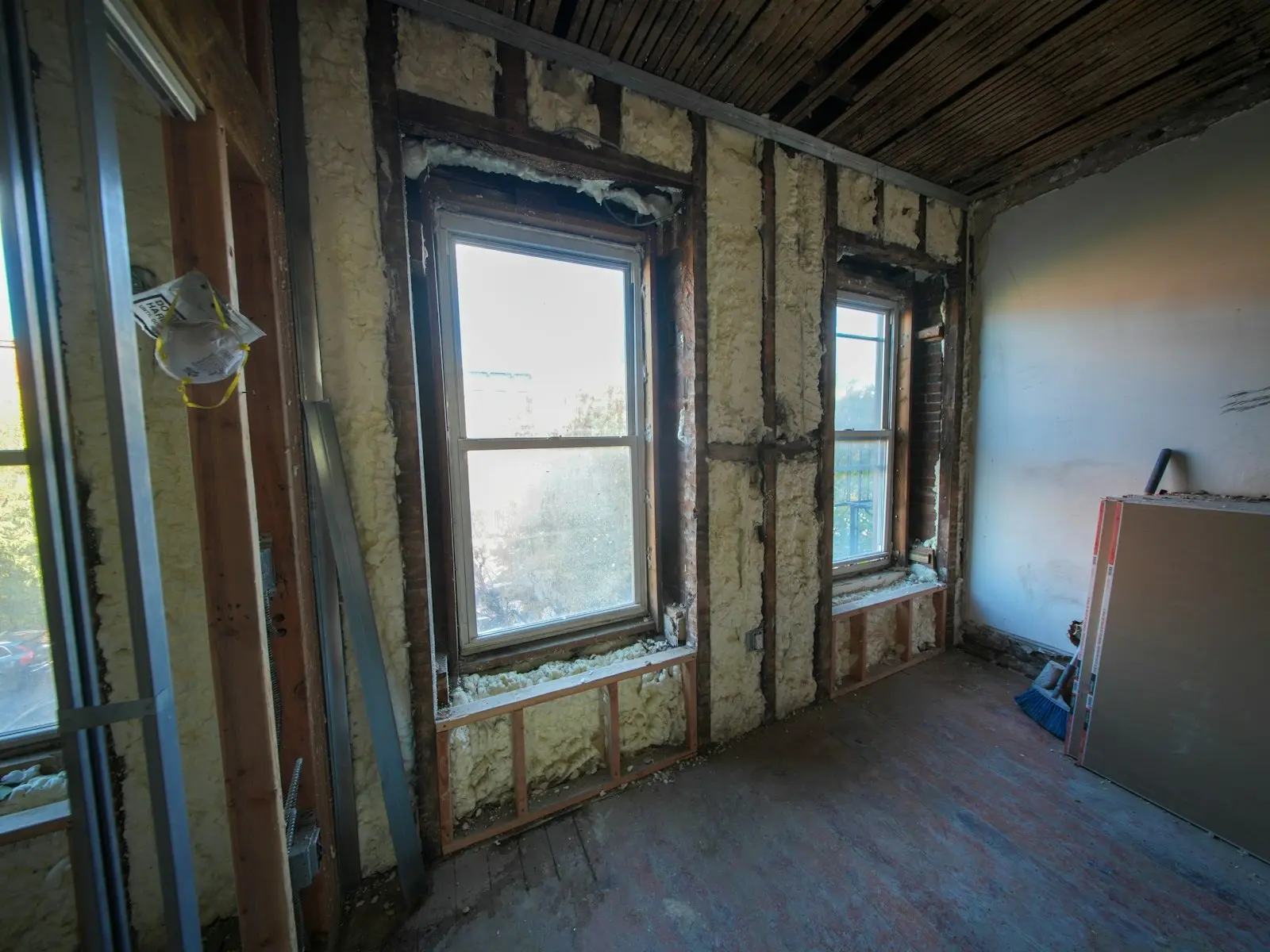
On an older house the siding has to come off first and go back on after. That's where the real money goes, and why I'd say this plainly: exterior wall insulation is a siding project with insulation inside it, not the other way round. If your cladding is healthy, the payback is slow. If it's failing anyway, the foam rides along for a modest extra. The exterior foam cost breakdown walks through the line items, and DIY or hire a crew covers who should hold the tools.
What Does a Basement Cost?
HomeGuide's basement guide (updated February 2026) gives rigid board at $1.20 to $3.70 per square foot of wall, installed. Its spray foam guide puts closed-cell foam at $3.00 to $5.00, with many contractors charging a $1,000 to $2,000 minimum. Neither range states a thickness, so read the gap as a spread, not a quote.
Here's the arithmetic for a basement with a 120-foot perimeter and 8-foot walls, which is 960 square feet:
| Material | Per square foot | 960 sq ft total |
|---|---|---|
| Rigid foam board | $1.20 to $3.70 | $1,152 to $3,552 |
| Closed-cell spray foam | $3.00 to $5.00 | $2,880 to $4,800 |
Those totals are my multiplication of the published ranges, not a measured job. The wall assembly matters more than the price here: foam goes against the concrete, never plastic over fiberglass. The moisture trap guide explains why, and the XPS vs spray foam comparison covers rodents, fire code and R-values.
What Would a Sensible First Budget Look Like?
Take a 1,000 square foot attic done by a crew and a 960 square foot basement done in rigid board. That's $1,400 to $2,500 plus $1,152 to $3,552, so about $2,550 to $6,050 in total. Swap in DIY cellulose and the attic drops to roughly $1,100 to $1,700.
Walls come later, ideally when the siding is due for replacement.
Is Any Rebate Left?
Not from Washington. The 25C credit expired on December 31, 2025, and Rewiring America's guide is explicit that installations after that date aren't eligible. State programs and utilities still run rebates, but they vary too much to list. Call yours before you sign.
How Do You Compare Two Quotes?
Ask for these as separate lines: air sealing, removal of old material, baffles or vapor details, the target R-value, and cleanup. A quote that bundles them hides the one thing you need to see, which is what's included.
Is the cheapest bid the right one? Rarely, if it leaves air sealing out. ENERGY STAR's savings figure is for air sealing plus insulation, so a bid without the sealing line isn't buying the result that number describes.
Heating is the next big-ticket decision after insulation, and it's worth sizing it only after the envelope is tight. The fall 2026 HVAC cost guide has the numbers. Buy the insulation first, and the furnace you need may be a smaller one.